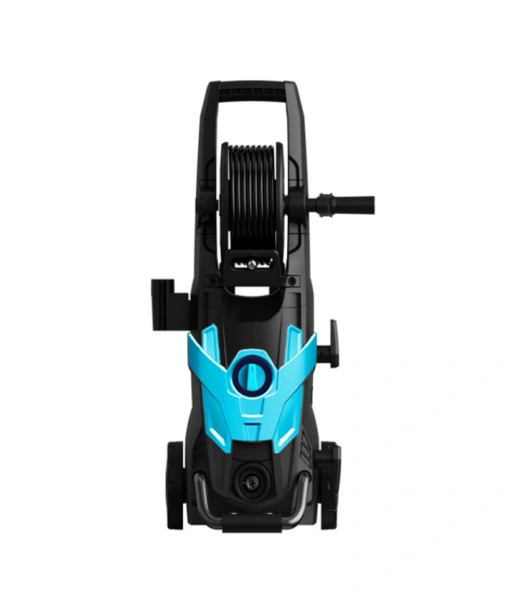
PSI determines impact force, GPM determines cleaning speed, and AC motor power determines how consistently the washer can deliver both.
For professional cleaning performance, all three must be balanced—especially in an induction motor pressure washer designed for continuous-duty applications.
Let's break down each factor from an industrial equipment perspective.
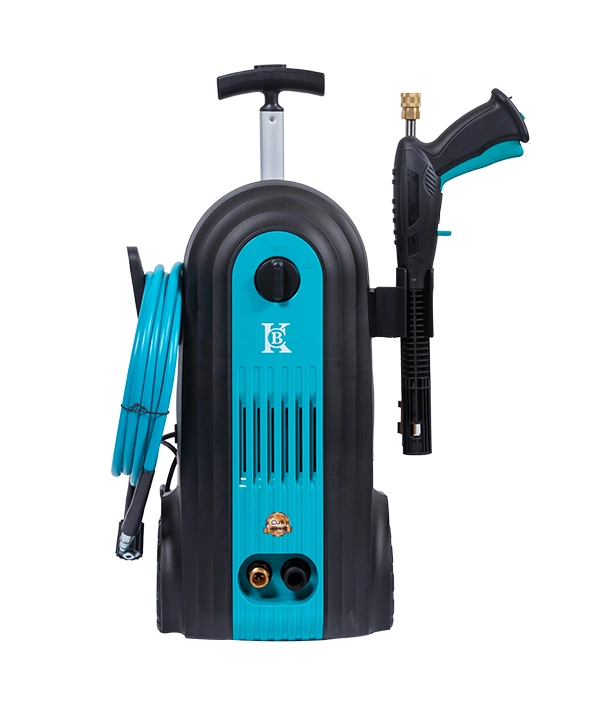
PSI (Pounds per Square Inch) represents the pressure the pump and motor can deliver to the nozzle.
Higher PSI means more force hitting the surface—but PSI alone can be misleading.
Industry insight:
An AC induction motor maintains more stable PSI under load because of its low-RPM, high-torque profile.
Universal motors might advertise "peak PSI" but drop significantly during actual cleaning.
Recommended PSI Levels:
1200–1500 PSI – Light commercial cleaning
1500–2000 PSI – Car detailing, workshops
2000–3000+ PSI – Industrial cleaning, construction, equipment washing
Does higher PSI mean better cleaning?
Not always.
PSI provides force, but without sufficient GPM, cleaning efficiency drops. True performance is a balance.
GPM (Gallons Per Minute) represents water flow. Professionals often consider GPM a more important metric than PSI.
Why GPM matters:
Higher flow removes dirt, mud, grease, and debris faster
Reduces cleaning time dramatically
Improves rinsing effectiveness
Enhances chemical application and flushing power
Example:
A 1800 PSI / 2.2 GPM machine cleans faster than a 2500 PSI / 1.3 GPM unit.
Industry formula:
Cleaning Units (CU) = PSI × GPM
But professionals know this number means little unless the motor can deliver stable torque.
In AC pressure washers—especially induction motor pressure washers—the motor determines:
Pressure stability (PSI consistency)
Flow maintenance (GPM retention under load)
Runtime capability (duty cycle)
Noise level
Heat generation
Product lifespan
Why AC induction motors are superior:
High torque at lower RPM (1400–2800 RPM)
Low heat generation supports long run-time
Minimal vibration protects pump components
Long lifespan (2000–4000 hours vs. 100–300 hours for universal motors)
Industry power ranges:
1.5–2.2 kW → Small commercial work
2.2–3.0 kW → Heavy commercial cleaning
3.0–5.5+ kW → Industrial-grade, three-phase systems
Motor power is the backbone. Without sufficient power, PSI and GPM drop dramatically during real cleaning tasks.
A. PSI needs motor torque
Induction motors deliver torque smoothly, ensuring PSI doesn't collapse under load.
B. GPM requires pump volume and motor stability
Low RPM + high torque = stable flow without cavitation.
Universal motors often fail here due to rpm fluctuations and overheating.
C. Motor power determines continuous duty operation
Industrial users require long, uninterrupted runtime.
Induction motors support 2–8 hour daily operation, while universal motors often overheat in 20–40 minutes.
Q: Is PSI or GPM more important for professional cleaning?
For commercial/industrial cleaning, GPM is more important because it determines how fast you can remove material. PSI helps break the surface, but GPM clears it.
Q: Do AC induction motors provide better pressure stability?
Yes. They deliver constant torque, resulting in steady PSI during long cleaning periods.
Q: Why do induction motor pressure washers last longer?
They have no carbon brushes, generate less heat, and operate at lower RPM, reducing mechanical strain.
Q: Does a bigger motor always mean more pressure?
Not always. Pump design and nozzle size play equal roles.
However, insufficient motor power definitely reduces real working pressure.
Light Commercial (Small Workshops, Car Detailing):
1200–1700 PSI
1.6–2.2 GPM
1.8–2.2 kW induction motor
Heavy Commercial (Fleets, Factories, Equipment Cleaning):
1800–2500 PSI
2–3+ GPM
2.2–3.5 kW induction motor
Industrial (Construction, Mining, Agriculture):
2500–3500 PSI
3–4.5+ GPM
3.5–5.5 kW three-phase induction motor
The more demanding the environment, the more essential a three-phase induction motor pressure washer becomes.
For any AC pressure washer—and especially for professional applications—the true performance comes from the relationship between PSI, GPM, and motor power.
PSI provides force
GPM provides cleaning efficiency
Motor power ensures both stay stable during real work
This is why professional users overwhelmingly choose an induction motor pressure washer: it maintains stable pressure and flow under heavy-duty, extended-operation conditions.
 English